
Some people rescue dogs. I rescue personal digital assistants from the trash.
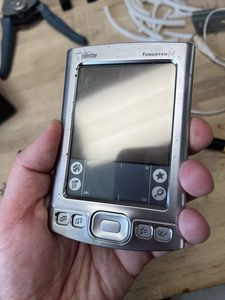
A few weeks ago I trash-picked a PalmOne Tungsten E2. For those of you under 30, a PDA was what we carried before smartphones ate the world — a little pocket computer for calendars, notes, and (if you were fancy) Bejeweled. The E2 came out around 2005. It has a 200MHz processor and a 320×320 color screen, which was genuinely impressive at the time. My phone now has more pixels than I have problems, and I use most of them to look at pictures of sandwiches.
So why did I drag it home? Honestly? Because it was THERE, and because somewhere in the back of my lizard brain a little voice said “I bet I could make that work.”
Turns out, I can!
The surgery
The battery was deader than disco. So I did what any reasonable adult does: I took the whole thing apart on my desk and started poking at it.
Now, a word about something this old: if your back and joints start wearing out after 20 years, imagine what happens to cheap plastic coatings. Those things get brittle, and one wrong move turns your restoration project into a parts donor. I treated everything in here like a bomb wire. (Blue wire? Orange wire? Don’t pull too hard!)
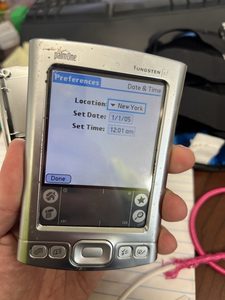
I got the battery sorted, hit the power button, and the screen lit up with “1/1/05.”
“IT’S ALIVE! IT’S ALIVE!”
(Yes, I said it out loud. Yes, my wife has heard worse coming from the computer room.)
Okay, but… why?
Fair question. Here’s what a 2005 PDA can actually do in 2026:
- Distraction-free writing. No notifications, no doomscrolling, just you and a little keyboard. Hemingway would’ve loved it. Probably. If he didn’t destroy the device trying to ‘type’ with Palm’s Jot Graffiti.
- Retro gaming. The Palm library is enormous, and yes, somebody ported Doom to it. Running Doom on a 200MHz PDA is not a good experience. It is, however, a GREAT experience.
- Universal remote. It’s got an infrared port, so with the right ancient software it can run your TV. Your TV remote wishes it had this kind of range anxiety.
- The real plan: a pocket AI terminal. This is where it gets fun.
Here’s the thing — the E2 speaks serial and ancient Bluetooth. It has no idea what WiFi is without an incredibly expensive add-on card (even in 2005), and it can’t do any modern encryption. But I’m a controls tech with a drawer full of ESP32s and a home server running local AI. The plan: wire a tiny ESP32 to the Palm’s serial port, let the ESP32 handle the WiFi and do the translating, and suddenly this 2005 pocket computer is chatting with my home lab. A cyberpunk pocket assistant with no cloud, no subscription, and it fits in a shirt pocket (which alone makes it better than my gigantic iPhone Pro).
Will it be practical? No. Will it be awesome? Yes! Definitely yes.
Sky’s the limit (time permitting)
Advances in AI and vibe coding are really what makes this all possible for a tinkerer with an addiction to disassembly. With AI doing the heavy lifting on code, the only real constraint on a project like this is time. Although time is the one thing that, with two kids and a full-time job, I have the LEAST of. But that’s fine. The Palm isn’t going anywhere. It’s waited 20 years; it can wait for me to finish the ESP32 bridge on a weekend winter afternoon.
There’s something deeply satisfying about pulling a piece of tech out of the trash and giving it a second life. It’s the opposite of everything our disposable-gadget culture wants us to do. Nobody’s getting rich off a Tungsten E2 in 2026. And that’s kind of the point. This piece of technology WORKS; I know because I made it work, and there’s no reason to keep it in the trash to rot!



Leave a Reply
You must be logged in to post a comment.